
Education for sustainable development
Education for Sustainable Development
On September 25, 2015, the “2030 Agenda for Sustainable Development” was adopted at a UN summit in New York. It takes the form of a global pact for the future and contains 17 Sustainable Development Goals (SDGs). The 2030 Agenda is the first international agreement to link the principle of sustainability with poverty reduction and economic, environmental, and social development. The Agenda aims to help ensure that all people worldwide can live in dignity. It aims to promote peace and to help ensure that all people can live in freedom and in an intact environment.
Source: 2030 Agenda for Sustainable Development | BMZ
The goal of Education for Sustainable Development (ESD) is to provide information about economic, environmental, and social interconnections. This is intended to empower people to make responsible decisions and take responsible action. ESD is an integral part of the museum’s mission statement and the foundation of our educational work. Through our educational programs and the exhibition, we inform our museum visitors about the working and living conditions of cocoa-farming families. We also explain the environmental consequences of cocoa cultivation and the ongoing problem of exploitative child labor. In doing so, we connect the local context with global developments.
Our Educational Concept
Guided Tour for School Groups
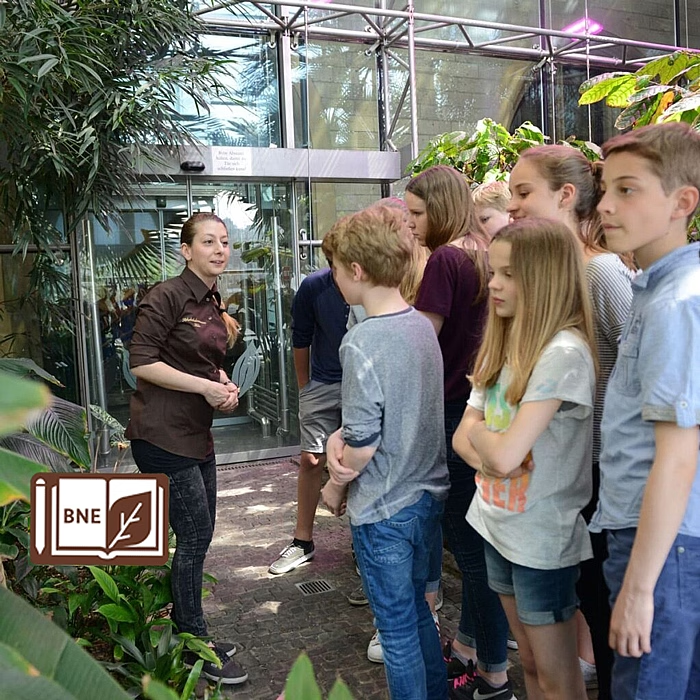
No cocoa, no chocolate! But who actually grows cocoa? What is daily life like for cocoa-farming families in the producing countries? In our tours, we highlight the working and living conditions in the major growing regions. We highlight where positive developments are already taking place, but also what still needs to be done. In our 90-minute tour, we broaden the focus to include a historical perspective. Under what conditions does cocoa make its way to Europe? What does cocoa farming have to do with colonial exploitation?
Each tour also includes a “fair trade” tasting, during which students can discover for themselves what the various labels found on packaging actually mean.
For middle and high
school students; duration: 60–90 min / max. 30 people.
Teachers accompanying the group receive free admission
. Group price starting at €80.00 plus admission
Educational Partnerships
ESD forms the foundation of all our educational programs. To facilitate an in-depth and sustained engagement with the topic of sustainability, the Chocolate Museum participates in the “Bildungspartner NRW: Impulse Museum” project
As an out-of-school learning venue, we supplement classroom instruction in various subjects to the best of our ability. When needed, we also visit partner schools for special activity days. The Chocolate Museum teaches ESD using the highly accessible examples of cocoa and chocolate. The goal is not merely to impart factual knowledge, but to help students recognize interconnections and thereby empower them to act independently in a sustainable manner.
If you are interested, please contact our museum education team:
museumspadagogik(at)schokoladenmuseum.de
Our Theme Week
Since 2018, the Chocolate Museum has hosted an annual theme week on sustainability and fair trade.
The Chocolate Museum will continue its commitment next year as well: Sustainability Week for schools will take place from June 21 to 25, 2027. Following that, the museum will host a family weekend on June 26 and 27.
The Chocolate Museum will continue its commitment next year as well: Sustainability Week for schools will take place from June 21 to 25, 2027. Following that, the museum will host a family weekend on June 26 and 27.
Are you interested in the 2027 Action Week?
Educational institution
To enhance the quality of our educational programs and become an even more attractive destination for learning and experiences outside of school, we obtained certification from the Nature and Environmental Protection Academy of North Rhine-Westphalia (Natur- und Umweltschutzakademie NRW) in 2018 in the area of Education for Sustainable Development (ESD): ESD
The Chocolate Museum is one of the first museums to have earned this certification. We were recertified in 2021, and in 2025 we received our second recertification, which is valid through 2030.
Since 2019, we have also been producing an annual sustainability report that provides detailed information about our activities and future goals in this area.
A place of learning with distinction
The Chocolate Museum was recognized by the UNESCO World Action Programme: Education for Sustainable Development on 20 November 2019.
What the jury says: "The Chocolate Museum Cologne is committed to making the social, economic and ecological aspects of the chocolate supply chain tangible for its visitors. In 3,500 guided tours, seminars and courses every year, visitors are encouraged to think about sustainability aspects in a target group-oriented way. The transformation of the Chocolate Museum into a place of learning for sustainable development has a strong role model character!" (Source: bne-portal.de)