MENTEGRA – The Mentoring Programme
How the Cologne Chocolate Museum supports refugee women as they enter the workforce. A look behind the scenes at the MENTEGRA mentoring programme.

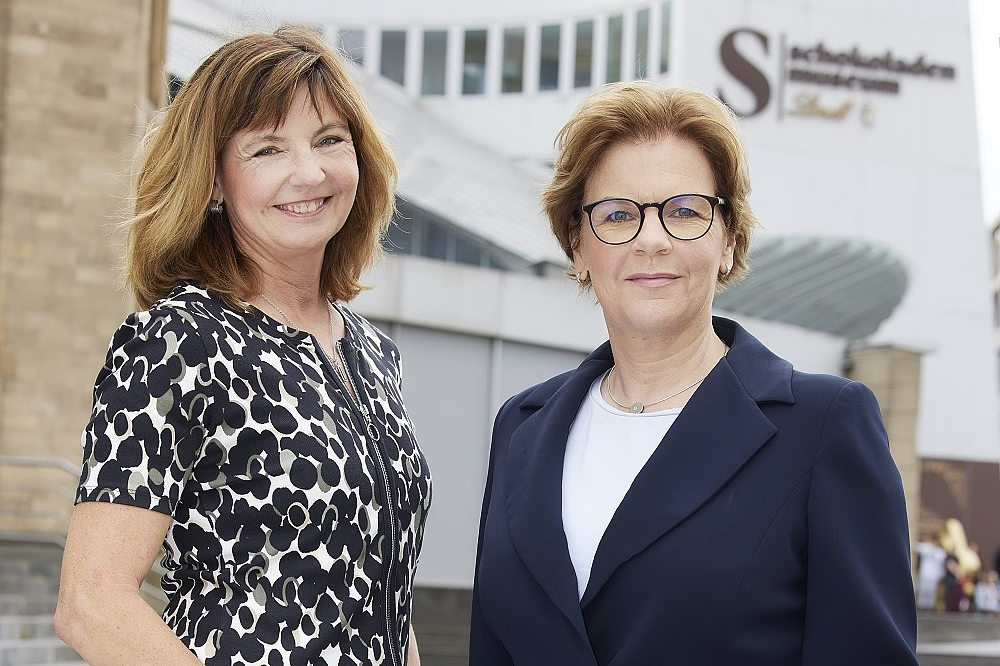
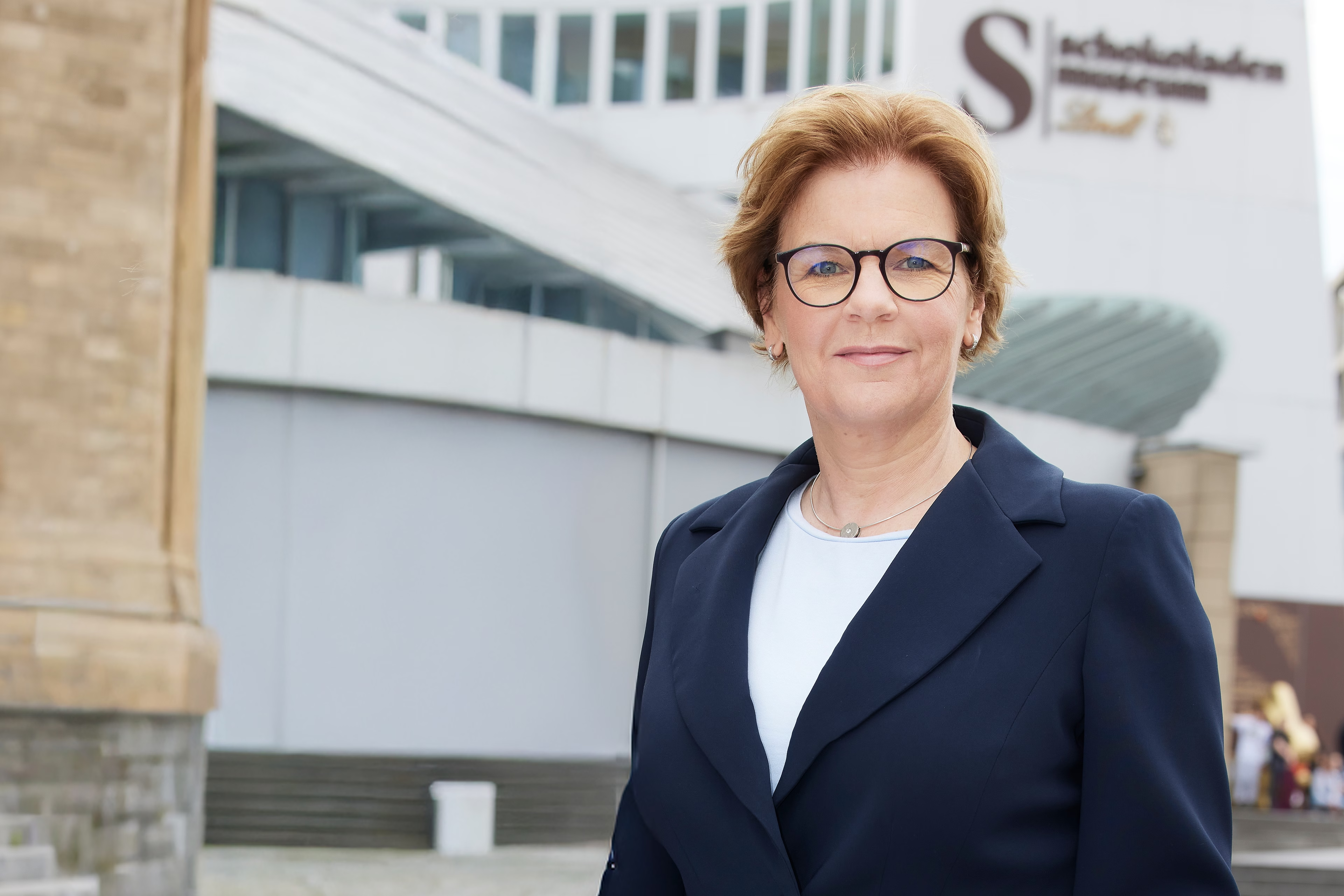
The Cologne Chocolate Museum has become a landmark of the city in many ways and has always been a family business. While Annette Imhoff—currently still together with her husband—takes care of the management, her sister Susanne Imhoff is dedicated to her role as chairwoman of the non-profit Imhoff Foundation. In an interview with DIE WIRTSCHAFT, the two talked about the foundation's work, the role climate protection plays for them, and what the renovation of the historic swing bridge is all about.
DIE WIRTSCHAFT: What role did chocolate play in your childhood? Your father said he had a "heart of chocolate."
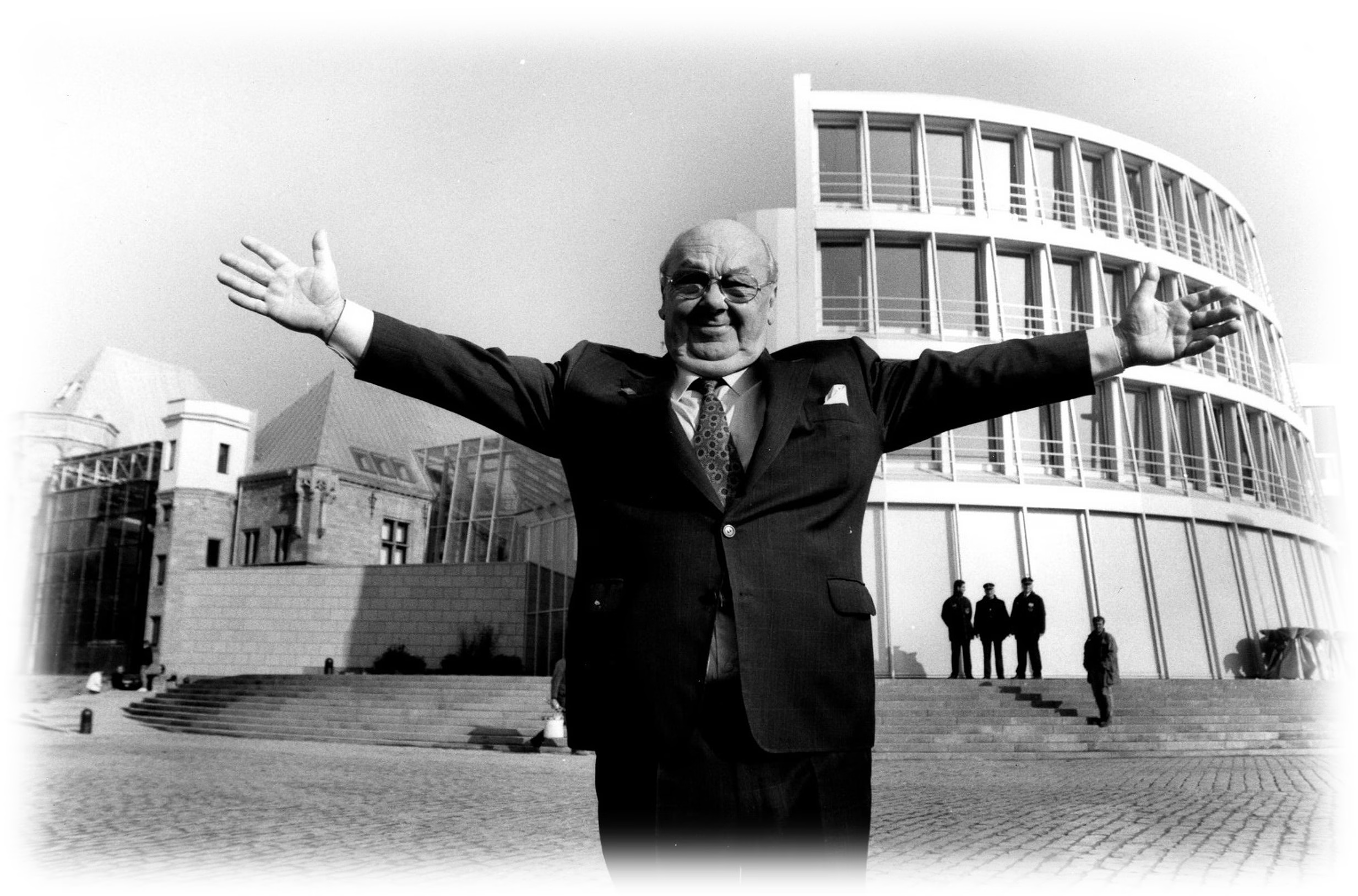
Susanne Imhoff: My father liked to say that he had a "heart of chocolate" – I think what he meant was that he felt inseparably connected to the chocolate empire he had built. Chocolate was much more than just a product for him; it was part of his own identity – he was completely merged with his company.
Unfortunately for me, chocolate was very rare in our home. I vividly remember a scene at a party where, as an eight-year-old, I grabbed a bar of Milka chocolate – completely unaware of what I was doing. The reaction of the others was a mixture of amusement and embarrassment, which I didn't understand at all at the time. Today, I see this as one of my earliest lessons in the delicate interplay between brand, family, and public perception.
Annette Imhoff: Our father was a man full of energy and passion—especially when it came to chocolate. His childhood was marked by deprivation, which may have been what gave it its special appeal: for him, chocolate represented warmth, enjoyment, and something precious. "
A heart of chocolate"—that was more than just a nice saying. It expressed his deep emotional connection to what he had created. The company was his life's work, built with instinct, courage, and great energy.
DIE WIRTSCHAFT: Ms. Susanne Imhoff, until a few years ago, you worked in a completely different industry as an educator, including as an equine therapist. Now you are the chair of the board of the non-profit Imhoff Foundation. What motivated you to give up your actual calling and follow in your mother's footsteps?
Susanne Imhoff: In fact, the change was less of a break with my calling and more of a step onto a new path with familiar values. The Imhoff Foundation's statutes stipulate that the chairmanship of the board must be filled by someone new once a certain age is reached—ideally someone from the family. As this moment approached, I already had the desire to return from Hamburg to Cologne and become more involved in the family. I was attracted by the challenge of familiarizing myself with a completely new field.
DIE WIRTSCHAFT: Both in your former work as an educator and in your current role, you help other people, albeit in different ways. Where do you see similarities and differences between your former and current work?
Susanne Imhoff: There was always a handwritten note hanging on my desk lamp, my basic approach to parent-teacher conferences and coaching assignments. "Give your own interpretations and explanations a reserved place. Remember that the other person's perspective and experience is different from your own." For me, this essentially means listening, understanding, and tolerating ambiguity. That note is still hanging there today—now on my desk lamp in the foundation office. It still brings me back down to earth often enough.
The biggest difference: In the past, I mainly had conversations with people who had settled into giving up, without drive, without ideas, without any sense of their own self-efficacy. Today, I talk to people who are driven by idealism and the awareness that they can shape, change, and improve things themselves. In combination with our support, I see how much can be achieved when commitment meets the right resources. That is very encouraging.
DIE WIRTSCHAFT: Since the foundation was established in 2000, almost 21 million euros have been invested in charitable projects – what determines what is funded and to what extent?
Susanne Imhoff: As with any charitable foundation, our funding purposes are laid down in our statutes – and they cannot be changed. The official foundation supervisory authority takes great care to ensure that we operate within this framework. Since we have six different foundation purposes, we cover a wide range of topics. This gives us flexibility, but also means that we receive very, very different project applications that are not subject to comparable criteria. We move between endowed professorships and theater workshops, senior citizen podcasts and classical concerts. We support exhibitions at memorial sites, the formation of a youth jury for film editing, and a writers' scholarship. Our values
compass provides us with guidance: criteria such as relevance, sustainability, social impact, a comprehensible financing plan, benefits for Cologne, and proof of qualifications play an important role.
However, the personal impression I gain in discussions with those responsible for the project is often decisive: Is there a noticeable connection to the project? Is communication transparent and honest? And above all: Does the project make a difference? Is something really better afterwards than before?
We are always happy to see projects that have the potential to continue to grow and have an impact after our initial support, without being dependent on us. That's every foundation's dream!
THE ECONOMY: The Imhoff Foundation does a lot for Cologne. Can you give us some examples from recent years?
Susanne Imhoff: To be honest, I don’t even know where to start. We support over 50 projects a year—that really adds up. But a few examples illustrate the breadth of our work quite well:
In the area of education, for example, there’s the “Bücherbande”—a completely new concept for promoting reading at the city library, featuring new formats, new approaches, and a great deal of creativity.
In the area of health promotion, we’ve helped establish the “Caring Community Köln”—a broad network of all relevant stakeholders dealing with dying, death, and grief in our city. It’s a sensitive and incredibly important topic.
And in the area of arts and culture promotion, there’s “Comedia 510”: an expansion of the COMEDIA children’s and youth theater to include a theater education and intercultural branch in Cologne-Mülheim—right in the heart of the city’s community.
These projects exemplify what we aim to initiate or make possible: initiatives that make Cologne an even better place to live.
DIE WIRTSCHAFT: The foundation is turning 25 this year. How are you celebrating?
Susanne Imhoff: For our 25th anniversary, we wanted to do something truly special—and above all, something that shifts the focus away from us and toward the people of this city. That’s why we launched the “Looking for People Who Make Cologne Better” campaign.
We’re calling on the people of Cologne to tell us, as part of this campaign, which club or nonprofit organization has specifically made their lives better. Touching, funny, exciting, loud, and quiet stories about themselves or their personal circles—which we’ll also share on social media, if they’d like. From all the submissions, a diverse jury will select 25 organizations—each will receive 5,000 euros from us as a token of our appreciation. Three of them will even win an anniversary prize of 25,000 euros each through a random drawing!
The campaign launched recently—and the response has been overwhelming. You can really feel how much dedication there is in this city. For us, this is the best way to celebrate: by shining a spotlight on those who make a difference day after day.
DIE WIRTSCHAFT: Ms. Annette Imhoff, you run the museum together with your husband, Dr. Christian Unterberg-Imhoff. Did it take a lot of persuasion to get him on board?
Annette Imhoff: My husband Christian and I have actually been working closely together since 1999—first at Larosé, and later at other companies within the Imhoff Group. So when it came to the Chocolate Museum in 2016, it was only natural that we take on the responsibility together. It didn’t take much convincing—we complement each other very well.
Christian has focused on the museum’s property, technical matters, and the collection and archives, while I’ve focused on the business side, visitor services, museum education, and marketing. In addition, we jointly manage our family foundations as well as the remaining companies in the group.
Now an important change is on the horizon: Christian will step down from his management role at the museum on June 30 and will devote more of his time in the future to our new project—the restoration of the historic swing bridge at the museum.
With Dominik Schröder, we’ve had an outstanding successor on board since April 1; we’ve known him since our time at Larosé and have great confidence in him.
DIE WIRTSCHAFT: What’s the story behind the restoration of the historic swing bridge?
Annette Imhoff: The historic swing bridge at the Chocolate Museum, which is a protected historic monument, is a technical masterpiece dating back to 1896. It weighs around 420 metric tons, is lifted hydraulically, and then swung to the side—a process that is still carried out about 100 times a year to allow ships to pass through to the Rheinauhafen, depending on the water level. Currently, it is only partially functional.
The bridge is owned by our nonprofit foundation. Recent inspections revealed significant damage, making a comprehensive renovation necessary. This will require the bridge to be completely removed from its moorings and overhauled on land—including the construction of a temporary replacement bridge.
The estimated total cost is approximately 7.5 million euros. We are very grateful that the city and the federal government have already pledged funding. Nevertheless, we will likely have to cover about half of the total cost from our own resources. Coordinating with the city, state, federal government, and historic preservation authorities is extremely complex—but we are firmly committed to preserving this significant structure for future generations.
DIE WIRTSCHAFT: Since 2019, the Chocolate Museum has been tracking and offsetting its emissions—how did you achieve this, what steps did you take, and what motivated you?
Annette Imhoff: For us, sustainability isn’t just an afterthought—it’s a fundamental part of our work. Back in 2016, my husband and I committed to consistently reducing the Chocolate Museum’s greenhouse gas emissions by 2023 and offsetting any remaining emissions —not in response to external pressure, but because we’re convinced that cultural institutions, too, must take responsibility.
We didn’t just want to talk about climate protection; we wanted to lead by example. That’s why we consistently invested in the following years—including in electricity from renewable energy sources and in energy-efficiency improvements. We offset remaining, currently unavoidable greenhouse gas emissions using recognized standards. This was important to us because we wanted to show that change is possible if you truly want it. As a place of education for sustainable development, we want not only to impart knowledge but also to demonstrate our commitment. It’s not about being perfect—it’s about getting started. And sticking with it.
DIE WIRTSCHAFT: In 2023, the exhibition "World Tour of Cocoa" opened, which is based on UNESCO's 17 sustainability goals. Was this part of your sustainability strategy?
Annette Imhoff: The Chocolate Museum is one of the most visited places in the region. This presents us with not only a great opportunity, but also a clear responsibility: we want to be a place that not only inspires, but also encourages reflection.
As part of Agenda 2030, the United Nations has formulated 17 goals for sustainable development – including zero hunger, decent work, sustainable consumption, and climate action. As a UNESCO-recognized learning center, we see it as our responsibility to make these issues tangible for our visitors.
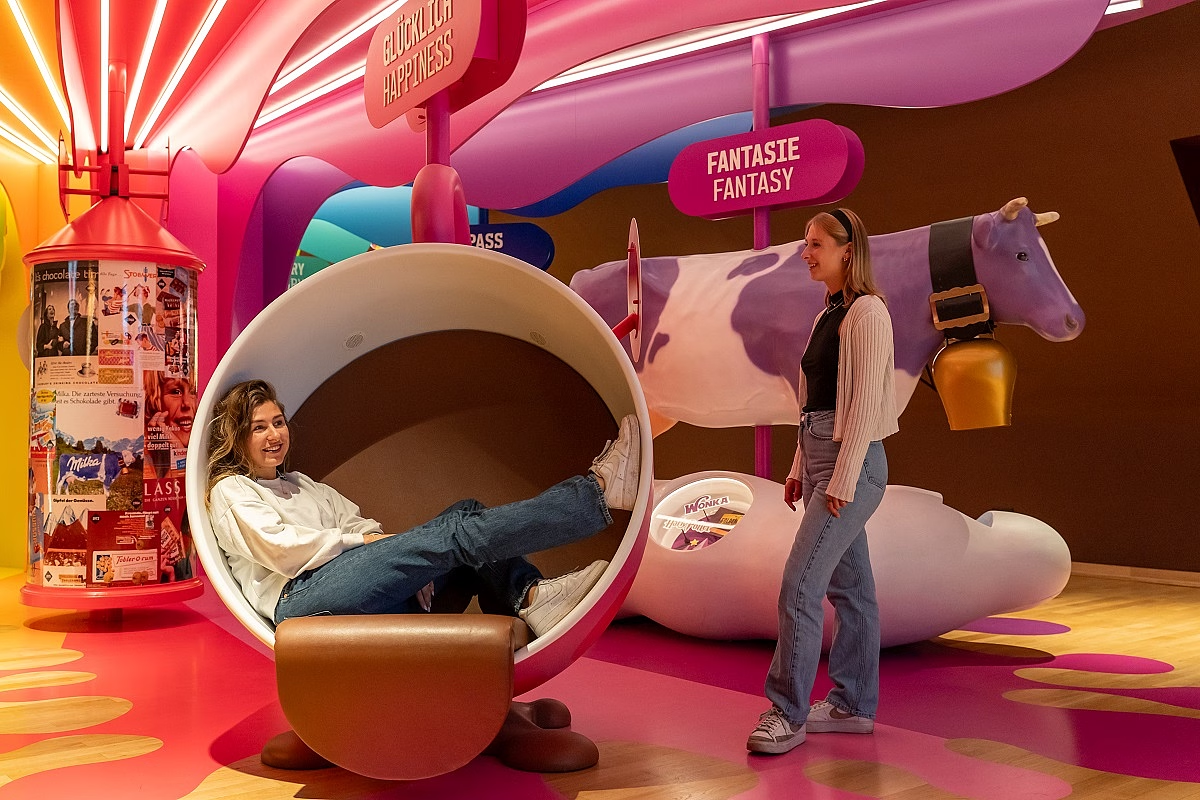
The exhibition "World Tour of Cocoa," which opened in 2023, is an important part of this strategy. It shows the origin of cocoa, its journey across the globe, and highlights the social, ecological, and economic connections along the supply chain.
This is because cocoa comes from a particularly sensitive region of our planet: the tropics. The cocoa sector is a complex system with many challenges. Our goal is to contribute to making this system more transparent, fair, and sustainable, step by step, through education and awareness.
THE ECONOMY: In 2024, the Chocolate Museum was not only by far the most visited museum in North Rhine-Westphalia, but also ranked 13th among the most visited museums in Germany. It thus represents a real economic added value for Cologne's economy and tourism – are there any collaborations with the city or Cologne Tourism to strengthen or further expand this symbiosis?
Annette Imhoff: We are closely networked with all relevant institutions in Cologne and the region. As part of the "Cologne Experience" tourist attraction, we see ourselves as an important component of the city's cultural and economic appeal.
If Cologne is doing well as a travel destination, the Chocolate Museum also benefits – and vice versa. With this in mind, we have been working successfully with Cologne Tourism for many years, as well as with Tourism NRW. The aim is to position Cologne as a culturally diverse and enjoyable travel destination in the heart of North Rhine-Westphalia.
Almost 50 percent of our visitors come from abroad – mainly from the Benelux countries, North America, France, and increasingly also from the Arab world. Overnight guests are particularly important for the city's economy – and they are also a key target group for us.
After all, almost everyone loves chocolate. That's why almost every tourist in Cologne is also a potential guest at the Chocolate Museum. This close symbiosis between city marketing and the museum has played a decisive role in enabling us to continuously increase our visitor numbers after Corona.
DIE WIRTSCHAFT: You also host corporate events. What aspects of these events are particularly interesting for company employees?
Annette Imhoff: Our location is truly unique: in the middle of the Rhine, right in front of the old town and with an unobstructed view of Cologne Cathedral. There is hardly any other place in Cologne where you can celebrate in such a central and impressive location.
Our Bel Etage and the CHOCOLAT Grand Café are high-quality event locations that are ideal for corporate events, but also for private celebrations such as weddings or anniversaries – from receptions to festive dinners.
Chocolate always evokes emotions, provides topics of conversation, and creates a bonding experience. That's exactly what makes events at our venue so special – and unforgettable for many guests.
DIE WIRTSCHAFT: What do you expect from politicians in the current situation?
Annette Imhoff: The list would be long – but essentially it boils down to two things: cleanliness, safety, and order on the one hand, and economic sustainability on the other.
People need to have confidence in a functioning, livable, and safe city. And we need a business-friendly environment that enables rather than hinders entrepreneurship. Only then can we generate the resources to tackle the major challenges of the future – from education to climate protection.
Politicians must once again take a more proactive role, enabling and providing guidance. This requires courage, clarity, and a genuine willingness to work together with business, culture, and civil society.
DIE WIRTSCHAFT: The following question is again for both of you: What are you particularly proud of in terms of your professional achievements?
Susanne Imhoff: I always feel a little uncomfortable with the word "proud." But there are moments when I realize that something special has been created – that something has been set in motion and would not have happened without me. Through a special conversation, through an extraordinary or courageous idea, through bringing people together or having the right instinct for things that are helpful right now. These are quiet but very satisfying moments of happiness that are perhaps best described by the word pride.
Annette Imhoff: In my professional life, I have had the incredible good fortune to be able to shape things very early on and to be entrepreneurially active. Entrepreneurial activity should also be value-driven and, of course, future-oriented. When success comes, then you can be a little proud of it.
(Authors: Jana Leckel and Eugen Weis)
I'm Astrid and I've been working in marketing at the Chocolate Museum for more than 10 years. It's one of the nicest places to work in Cologne and there are always great stories to tell about cocoa and chocolate. Where else can you get such a great view of the Rhine right from your desk?